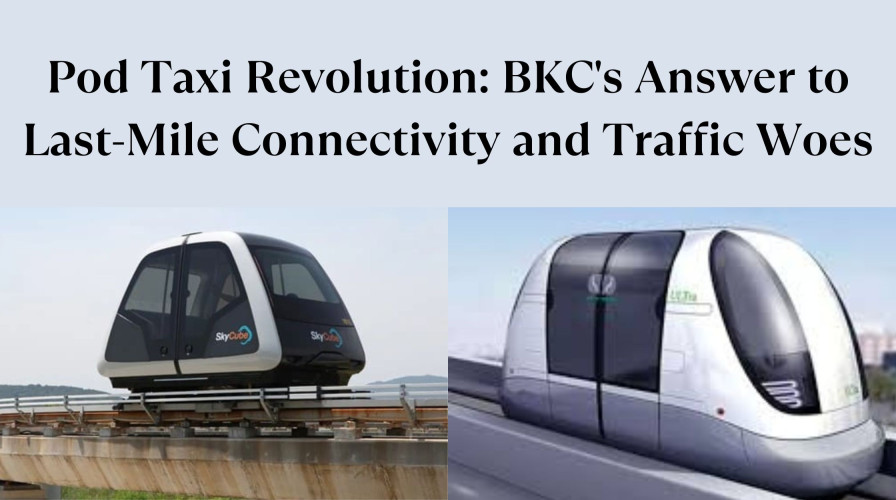
Mumbai’s bustling business district, Bandra Kurla Complex (BKC), is set to receive a much-needed boost in transportation infrastructure with the introduction of a futuristic pod taxi system. The Mumbai Metropolitan Region Development Authority (MMRDA) has greenlit this Automated Rapid Transit System (ARTS), which aims to alleviate the district's notorious traffic congestion and improve last-mile connectivity for its daily commuters. The project, awarded to Hyderabad-based Sai Green Mobility, is expected to serve over 600,000 people every day once completed.
A Game-Changer for BKC Commuters
With commuters constantly struggling to access BKC from nearby railway stations and public transport hubs, the pod taxi system promises to be a game-changer. Currently, a mismatch between the demand for public transport and its availability has led to severe congestion despite the presence of buses and shared autos. The pod taxis will offer an efficient alternative, operating every 15-30 seconds and connecting key locations such as Bandra and Kurla suburban stations, the upcoming BKC metro station, and the future bullet train terminal.
This 8.8-kilometer route will feature 38 stations, ensuring seamless access across the sprawling business hub. Designed for convenience, the autonomous pods will seat up to six passengers and travel at speeds of up to 40 km/h, providing a quick and comfortable commute.
Project Timeline and Cost
The total cost of the project is estimated at ₹1,016.34 crore, with a concession period of 30 years for Sai Green Mobility to manage operations under a Design-Finance-Build-Operate-Transfer (DFBOT) model. The project is expected to be fully operational within three years, bringing relief to the 400,000 to 600,000 daily commuters who travel to and from BKC.
A comprehensive Techno-Economic Feasibility Study (TEFS), commissioned by the MMRDA and peer-reviewed by Tata Consulting Engineers, led to the final decision to implement the pod taxi system. The study confirmed that the system would be well-suited to the area’s topography and capable of handling the expected traffic growth, making it the ideal solution for BKC’s transportation challenges.
Fare Structure and Accessibility
The pod taxis will charge a fare of ₹21 per kilometer, with an annual increase of 4% to ensure long-term operational sustainability. This fare structure is seen as competitive, especially in comparison to existing options such as shared autos, where commuters often pay up to ₹40 per ride.
Once operational, the pod taxi system will significantly reduce the reliance on traditional modes of transport, easing the pressure on internal roads and improving the overall flow of traffic. This is particularly crucial as the area’s footfall is expected to increase with the completion of new infrastructure projects such as the bullet train.
A Modern Solution to an Age-Old Problem
BKC has long grappled with traffic congestion and poor connectivity, despite being a vital commercial hub in Mumbai. The introduction of the pod taxi system is a significant step towards modernizing the city’s transportation network. Not only will it provide efficient last-mile connectivity, but it will also reduce traffic congestion and offer commuters a more comfortable, reliable, and high-tech mode of transport.
The MMRDA’s decision to approve the project underlines the importance of urban mobility solutions in an ever-expanding metropolis like Mumbai. As BKC continues to grow as a business hub, the pod taxi system is poised to become an integral part of its transport ecosystem, setting a new standard for urban transit in India.
Related Tag :